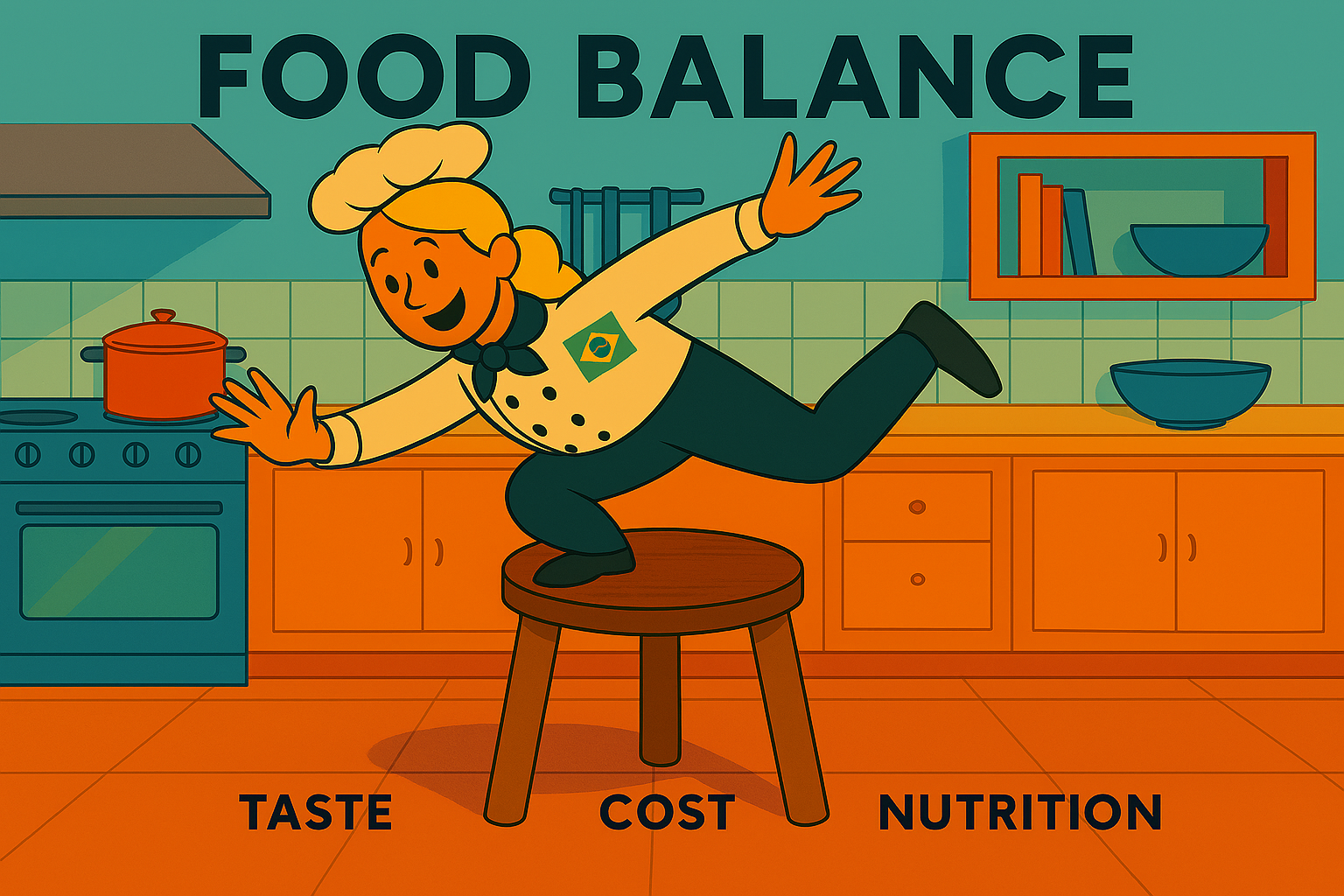
Food for kids and seniors is a balancing act between three elements: taste appeal, low cost and nutritional value. The bad news is that you can at best rate high on two out of the three, sometimes only one of the three. It is like the old Russian proverb that said you cannot be at the same time intelligent, communist and sincere. You can be intelligent and communist if you’re not sincere. Or you can be intelligent and sincere, but then you’re not communist. And if you are communist and sincere, then you’re not intelligent.
So what is a chef to do? The food that has the greatest taste appeal tends to be more expensive (think beef instead of chicken, or pineapple vs. red apple) or less nutritive (witness the popularity of pasta vs., say, garbanzo beans). The food that has the lowest cost tends to be less appealing and less nutritive (say, frozen vegetables from Sysco vs. fresh squash from a local farm). And the food that has the highest nutritional value tends to have less appeal: it is harder to get kids to eat any vegetable compared to French fries of chicken nuggets (and seniors may not BE as different from kids as you think).
The balancing act is further compounded by the fact that three different populations evaluate each dimension. Kids and seniors worry about taste because they eat the food (or throw it away). Food suppliers care about cost because they worry about survival. And parents and the regulator focus on nutrition (plus a few seniors who care about what they eat). These three populations never meet to discuss the trade-offs involved. As a result, the chef is like an orchestra conductor whose instrumental sections are in different locations: strings are in New York, the wind section in Chicago, and the brass section in San Francisco. And all three sections blame the conductor for the cacophonous execution of the symphony.
Fortunately, a few schools’ or senior organizations’ Nutrition Managers play the conductor role and successfully integrate the three roles. Some charter schools, for example, have nutrition leaders that convincingly advocate for the kids and select vendors on the basis of the quality and variety of the food they offer, while also making sure the food has high nutritional standards. Some even care about not putting their vendor out of business and understand vendors cannot serve beef and seasonal vegetables every day. But they are few and far between.
Sadly, most public schools and senior organizations pick the food suppliers solely on the basis of the lowest cost (also requiring that selected vendors also meet the minimal nutritional requirements mandated by the legislator). Food regulators such as the USDA (and its local Massachusetts representative the Department of Elementary and Secondary Education) and local cities and town even mandate the selection of the cheapest vendor.
About Francis Gouillart
Francis Gouillart is a business strategist, author, and co-founder of Stock Pot Malden. He is best known for his work on co-creation and innovation, helping organizations rethink how value is created by engaging people, partners, and communities more deeply in the process. Through his writing and hands-on ventures, Francis explores how economic systems, leadership, and entrepreneurship can be redesigned to drive both performance and social impact.
About Stock Pot Malden
Stock Pot Malden is a social-impact driven food innovation hub in Malden, MA, dedicated to transforming how quality meals are made and served in our community. Since 2014, we’ve supported the growth of diverse local food entrepreneurs through our licensed shared kitchen incubator while providing fresh, culturally appropriate, and affordable prepared meals to schools, senior centers, childcare programs, and families across Massachusetts. Our unique model not only delivers more than millions of meals each year but also fuels business creation and economic opportunity by pairing culinary talent with the resources they need to succeed.